Five common recycling misconceptions – and what you really need to know to get it right.
Recycling is something most of us are trying to get right, but with so much information around about what can and can’t be recycled, it’s easy to become confused. At Waiuku Zero Waste, we hear many of the same questions and misconceptions week after week. Sometimes it’s because the rules have changed, sometimes because different councils have different systems, and sometimes because something simply looks like it should be recyclable (or can’t be).
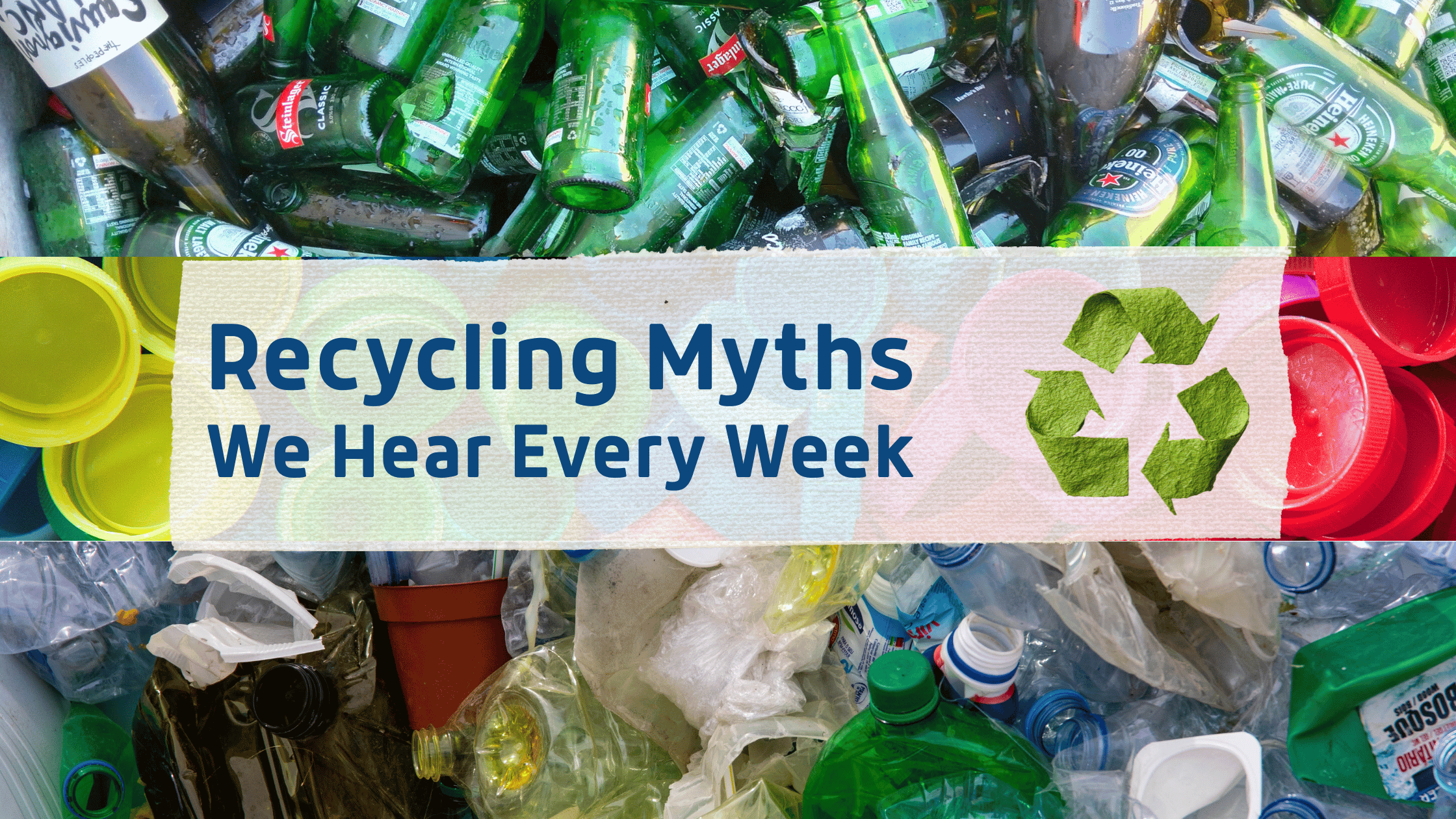
Following Recycling Week, we thought we’d tackle some of the recycling myths we hear most often. Because getting recycling right isn’t about being perfect – it’s about understanding what happens to our waste and making better choices where we can.
Myth #1: “It all ends up in landfill anyway, so why bother?”
This is one of the most common recycling myths we hear – and it’s easy to understand where it comes from. People sometimes see news stories about recycling being contaminated, hear that some materials are sent to landfill, or notice that not everything placed in a recycling bin ultimately gets recycled. So, it’s tempting to think: “What’s the point? It all ends up in landfill anyway.” There is some truth behind the concern, but the conclusion is wrong.
Not everything placed in your recycling bin will necessarily be recycled. Some items are not accepted by the recycling system in the first place, while other recyclable materials may be too contaminated to be recovered. When items that can’t be recyclable and mixed in with recyclable items, unfortunately the whole compacted bale of items will need to be sent to landfill due to contamination.
When you put a clean, accepted recyclable into your kerbside recycling, it has a pathway to be sorted, processed and turned into something new. When you put the wrong thing in – such as food waste, textiles, batteries, nappies or other rubbish – it may have to be removed during sorting. Worse, some contaminants can affect other materials around them.
So yes, some material that goes into recycling bins does ultimately end up in landfill. But that doesn’t mean that all recycling does, or that putting your recycling in the right bin is pointless. In fact, the better we get at putting the right things in the right place, the more useful material we can recover.
So, the next time someone says, “It all just ends up in landfill anyway,” the answer is: while some does – a lot doesn’t. And what we put in the recycling bin makes a difference.
Myth #2: “Broken glass doesn’t go in the recycling.”
This is one of those recycling myths where the answer isn’t quite as simple as “yes” or “no” – and it’s a particularly relevant one for us here at Waiuku Zero Waste because we’re right on the Auckland–Waikato border.
The first thing to understand is that not all glass is the same. Auckland’s kerbside recycling system is designed to accept glass food and beverage bottles and jars. These are made from a particular type of glass that can be processed and recycled back into new glass products.
So that means that not every glass item belongs in the recycling bin.
Drinking glasses, wine glasses, Pyrex and other ovenware, mirrors, window glass and other types of flat glass are made differently. They can have different compositions, melting points, coatings or other materials incorporated into them. If these types of glass are mixed with bottle and jar glass, they can cause problems during the recycling and remanufacturing process.
So, in Auckland, your empty glass sauce jar or drink bottle belongs in the recycling bin. Your broken drinking glass or old Pyrex dish does not.
There is also an important distinction when it comes to broken bottles and jars. Auckland Council’s kerbside system allows large pieces of broken bottle and jar glass to be recycled. So, if a glass food jar or bottle breaks, don’t assume that all the pieces automatically belong in the rubbish. However, broken glass needs to be handled carefully, and Auckland’s guidance is specific about the size and type of glass that can go into the kerbside system.
If you live just across the border in the Waikato, however, the rules are different. Waikato District Council’s kerbside recycling service specifically excludes broken glass. Its recycling is collected in separate crates and handled by people.
This is a good reminder that recycling rules aren’t necessarily universal. If you live in Waiuku or elsewhere in Auckland, follow Auckland Council’s guidelines. If you live across the border in the Waikato, check the Waikato District Council rules for your collection service.
So, the lesson isn’t simply “don’t recycle broken glass”. It’s know what type of glass you’re dealing with, and know which recycling system you’re using.
Myth #3: “Pizza boxes aren’t recyclable.”
This one is a little more complicated – because pizza boxes can be recyclable.
The cardboard itself is perfectly suitable for recycling, but the condition of the cardboard matters. A pizza box with a few grease marks is generally fine for the paper and cardboard recycling stream. A box containing leftover pizza, large amounts of food or heavily contaminated cardboard is another matter.
Food contaminants can cause problems during the recycling process. So, before putting your pizza box into the recycling bin, remove any leftover food and separate out any sections that are heavily contaminated.
This is a good example of why recycling isn’t always about simply asking “Is this material recyclable?” The better question is often “Is this item recyclable in its current condition?”
The same applies to many of the things we put in our recycling bins. A recyclable material can become unrecyclable if it is contaminated with food, liquid or other waste.
Myth #4: “If it has a recycling symbol, I can put it in my recycling bin.”
Those familiar recycling arrows can be confusing. We see the symbol on packaging and quite reasonably assume that it means the item can go straight into our kerbside recycling bin. But the recycling symbol doesn’t necessarily mean that. A symbol or recycling label can tell us something about the material a product is made from or indicate that it may be recyclable somewhere. It doesn’t necessarily mean that your local kerbside collection accepts it, or that a recycling facility exists in your area to process it. This is an important distinction because recycling isn’t just about whether something is technically recyclable. There needs to be a collection system, a facility capable of processing the material and a viable end market for the recovered material.
Tetra Pak cartons are an example of this – they can be recycled, but they aren’t accepted in Auckland’s kerbside recycling system. Instead, they need to go through a specific collection and processing pathway. Here in Waiuku, you’re lucky that Waiuku Zero Waste accepts Tetra Pak cartons for recycling. We send them to SaveBOARD, where they are transformed into carbon-negative building products. But that doesn’t mean every community has a collection point for Tetra Paks. If there is no appropriate recycling pathway available in your area, an item that is technically recyclable may unfortunately still need to go into the rubbish.
That’s why the best question isn’t simply, “Does this have a recycling symbol?” Instead, ask: “Is this accepted in my local recycling system?” The answer can be different from one council, region or country to another. Something that is collected for recycling in one place may have no recycling pathway somewhere else. So next time you see those familiar recycling arrows, don’t automatically put the item in your recycling bin. Check what the symbol means, check your local recycling guidelines, and look for a collection point if the material isn’t accepted at kerbside.
Recycling is a system, not just a symbol.
Myth #5: “Once I’ve finished with it, I can just put it straight in the recycling bin.”
It’s easy to think that once we’ve finished using something recyclable, it can go straight into the recycling bin. Empty the yoghurt container, finish the last of the milk, eat the last of the leftovers – and into the recycling it goes.
But recyclable packaging still needs to be reasonably clean before it goes into the recycling bin.
That doesn’t mean you need to scrub every container until it’s spotless. The important thing is to empty out any remaining food or liquid and give the container a quick rinse. The aim is to remove enough of the residue that it won’t contaminate other recyclable material during collection, sorting and processing.
This is particularly important with containers that have held food. Scraping out the last of the yoghurt, jam or sauce and giving the container a quick rinse can make the difference between it being suitable for recycling and being too contaminated to recover. The goal is not perfection – it’s keeping recyclable materials clean enough to be processed.
The problem with “wish-cycling”
All of these myths have something in common: they can lead to what is often called “wish-cycling” – putting something into the recycling bin because we hope it can be recycled, rather than because we know it can.
It’s an understandable habit. We want to recycle. We don’t want something going to landfill. So, when we’re unsure about an item, putting it in the recycling bin can feel like the environmentally responsible choice.
Unfortunately, wish-cycling can have the opposite effect.
An unsuitable item can contaminate other materials, create safety risks for workers or simply have to be removed and sent to landfill. In some cases, it can also damage equipment or disrupt the sorting process.
That’s why “when in doubt, leave it out” is useful advice – but even better is to find out where the item actually belongs.
Recycling isn’t the whole answer – but it still matters
At Waiuku Zero Waste, we’re big believers that recycling is only one part of the waste hierarchy. The best waste is waste that isn’t created in the first place. Reducing what we buy, choosing reusable products, repairing things when we can, buying second-hand and finding new homes for things we no longer need can all have a bigger impact than recycling alone.
But recycling still has an important role to play.
When we put the right materials into the right recycling system, we give those resources a chance to be recovered and used again rather than sending them straight to landfill. And when we understand what doesn’t belong in our recycling, we help protect the quality of the materials that do.
So, if you’ve ever stood over your recycling bin wondering whether something “probably” belongs in there, you’re not alone. Take a moment. Check the local guidelines. Ask your local recycling centre. Find another reuse or recycling option if one exists. A few seconds of checking can prevent an entire load of recycling from being contaminated. And that’s something worth getting right.
Got a recycling myth you’d like us to bust?
These are just some of the questions we hear regularly at Waiuku Zero Waste or in the community. If there’s something you’ve always wondered about, we’d love to hear from you. Your question could become the subject of our next Recycling Myth.